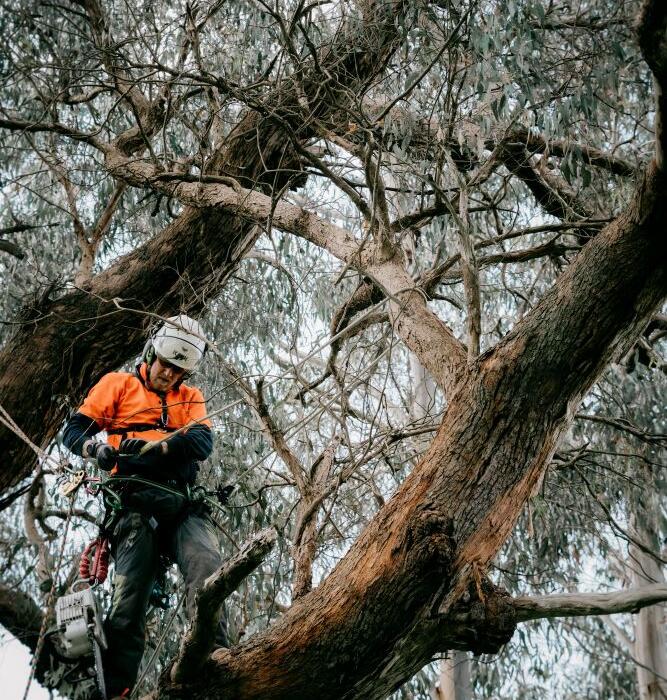
Arborist services across Geelong, Colac, Surf Coast and the Bellarine Peninsula
Deciding between tree pruning and tree removal is not simply a question of how large or untidy a tree has become. Pruning selectively removes branches to manage a tree’s structure, condition or clearance, while removal eliminates the entire tree when retaining it is no longer appropriate. For property owners across Geelong, the Surf Coast, Bellarine Peninsula and Colac, the right decision depends on the tree’s health, structural condition, location and the risk it presents to people or property.
In many cases, a tree that looks concerning does not need to be removed. Equally, repeatedly pruning a tree with serious structural problems may not resolve the underlying risk. Understanding the difference is the first step.
When is tree pruning the right option in Geelong and surrounding areas?
Pruning is generally appropriate when the tree itself remains viable but particular branches or parts of its canopy require attention.
Dead, dying, diseased, broken or weakly attached branches can often be selectively removed while retaining the healthy tree. Pruning can also address branches that rub or cross, improve clearance around buildings and access areas, and reduce particular structural concerns.
The common reasons for pruning mature trees include removing dead branches, improving form and reducing risk. Importantly, pruning should have a defined purpose. Removing excessive live foliage can place unnecessary stress on a mature tree.
This distinction matters. A few dead branches do not automatically mean the whole tree is dying. The question is whether the problem is isolated to individual limbs or indicates a broader decline or structural defect.
What signs suggest a tree may need to be removed?
Tree removal becomes more likely when defects affect the tree as a whole and cannot be adequately managed through pruning.
Warning signs can include significant trunk failure, major structural splits, extensive decline, severe storm damage, substantial root failure or instability. A tree that has started leaning after a storm, particularly where the surrounding soil or root plate has lifted, requires professional assessment.
Location also affects the consequences of tree failure. A structurally compromised tree beside a house, school, workplace, road or frequently used pedestrian area presents a different level of risk from the same tree in an isolated area.
Tree Division’s tree removal service identifies diseased or dying trees, weakened structures and trees creating hazards or obstructions among the situations where removal may be required.
Removal should therefore be based on the condition of the tree and the consequences of potential failure, rather than appearance alone.
What about dead, diseased or storm-damaged branches?
Storm damage can make the prune-or-remove decision more urgent.
A tree may lose one or more substantial limbs while retaining a sound trunk, root system and enough healthy canopy to recover. In this situation, appropriate pruning may be sufficient. More extensive damage, such as a major trunk split or loss of structural stability, may make retention impractical. Hanging limbs, newly leaning trunks and disturbed root plates are identified as reasons to treat the area as a potential hazard and seek professional assessment.
After significant wind or storms, avoid assuming that a standing tree is necessarily a safe tree. Some defects are difficult to identify from ground level.
What if branches are overhanging a house or powerlines?
A branch extending towards a roof does not necessarily justify removing the entire tree. Where the tree is otherwise healthy and structurally suitable, targeted pruning may provide the required clearance.
Powerlines require particular caution. Victorian Government guidance advises people not to attempt to prune or remove trees that have fallen onto powerlines and recommends contacting the relevant electricity distributor about trees growing close to electrical infrastructure.
The objective should be to manage the actual hazard without unnecessarily compromising the tree.
When is an arborist assessment worthwhile?
An arborist assessment is particularly useful when the answer is not obvious. An arborist can consider the tree’s health, structure, defects, surroundings and potential targets if a branch or the tree were to fail.
Assessment is especially worthwhile after major storm damage, when a tree has developed a new lean, when significant limbs are failing, or when pruning would need to remove a substantial proportion of the canopy.
Local planning controls also matter. For example, Surf Coast Shire advises property owners to check applicable planning overlays and permit requirements before removing or trimming protected vegetation. Requirements vary by property and municipality, so checking before work begins can prevent an expensive mistake.
The aim is not to prune or remove more than necessary
Good tree management starts by identifying the problem rather than choosing the treatment first. If a healthy tree has manageable branch defects or clearance issues, professional pruning may allow it to remain safely in the landscape. If serious structural failure, instability or decline means the risk cannot reasonably be managed, removal may be the more appropriate option.
For trees in Geelong, the Surf Coast, Bellarine Peninsula or Colac, Tree Division can assess what is happening and recommend an appropriate course of action. Contact Tree Division to discuss whether your tree needs pruning, further assessment or removal.